English
  Español
Updated June 24, 2026
Aging, pregnancy, weight loss, and genetics can all contribute to sagging breasts. While these changes are a natural part of life, many women find that their confidence and comfort are affected when their body no longer reflects how they feel inside. A breast lift, also known as mastopexy, is a cosmetic procedure that can help improve the appearance of sagging breasts by lifting and reshaping them.
There are different types of breast lifts, and the choice of procedure depends on the degree of sagging and the desired result. Whether you want to restore your confidence after nursing several babies or feel more comfortable in how your clothes fit, we can help. Let’s look at what a breast lift at Neaman Plastic Surgery can accomplish and the most popular types.
WHAT IS A BREAST LIFT?
A breast lift lifts and reshapes sagging breasts by removing excess skin, tightening the breast tissue to lift and reshape the breasts, and repositioning the nipple and areola higher on the breast mound. It can help:
- correct asymmetry
- improve the overall shape and position of the breasts
- create a more youthful and lifted appearance
TYPES OF BREAST LIFTS
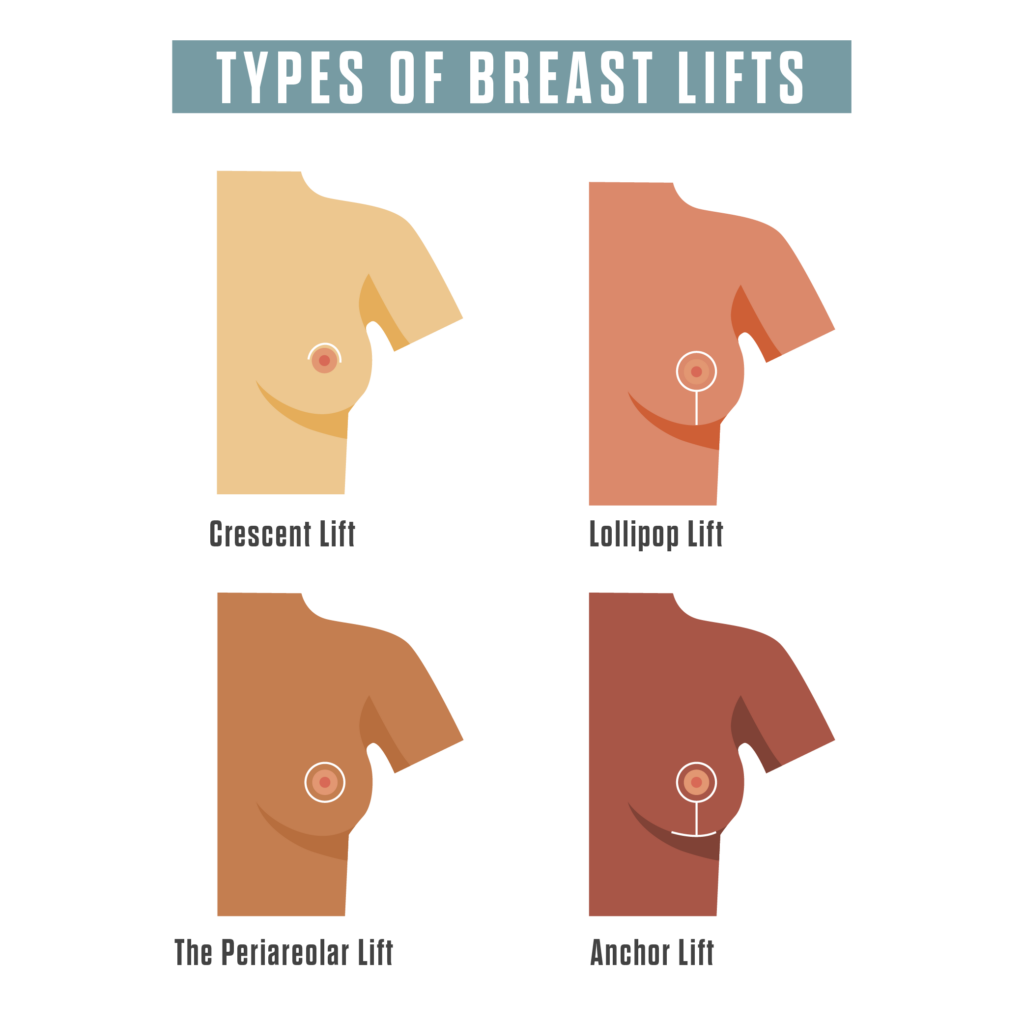
Some of the most popular types of breast lifts include the following:
Crescent Lift
Ideal for minimal sagging, a crescent lift uses a small, crescent-shaped incision along the top edge of the areola to remove excess skin and create a subtle lift. The result is a more youthful, perky appearance without significant scarring.
The periareolar lift
Also known as a “donut lift,” this technique involves making a circular incision around the areola and removing a small amount of skin to lift the breast. It’s often used to address mild sagging and can help improve the shape and position of the nipple with a subtle lift.
Lollipop Lift
A lollipop or vertical lift is a traditional breast lift ideal for women with moderate sagging. This technique uses two incisions– around the areola and vertically down the breast– creating a lollipop-shaped scar. During the procedure, a surgeon removes excess skin and tissue, reshapes the breast, and repositions the nipple and areola to a higher location on the breast.
This is a very effective lift for many women with low-hanging breasts because it offers more reshaping than some of the less invasive approaches.
Anchor Lift
The anchor lift, also known as an inverted T lift, is a traditional breast lift ideal for women with significant sagging. This approach involves making incisions around the areola, down the center of the breast, and along the breast fold to remove excess skin and reshape the breast. While more involved than other types of breast lifts, it can produce dramatic results by lifting and reshaping the entire breast.
How to Choose the Right Breast Implants for Your Breast Lift
If you’re combining a breast lift with your augmentation, you’ll have to make several decisions about your implant. During your consultation, your surgeon will help you choose the implant type, size, profile, and placement that best fits your aesthetic goals.
Silicone vs. Saline Breast Implants
Most women choose between saline vs. silicone implants. Silicone implants are known to be softer and have a more natural feel. They also tend to show less visible rippling, which is when the implants wrinkle underneath the skin. Some of our patients also opt for ‘gummy bear implants,’ which are highly cohesive silicone implants designed to maintain their shape while reducing rippling.
Saline implants are filled after placement, which allows for a slightly smaller incision. They’re often slightly more affordable, and if a rupture occurs, the implant deflates as the body safely absorbs the saline solution.
Silicone and saline implants usually have similar healing timelines, but since silicone implants are already filled, they may require slightly larger incisions. Most patients can return to light activity within a few days of surgery and resume more strenuous exercise after several weeks.
Implant Profiles and Sizing
Implant size affects the overall volume of the breasts, while implant profile determines how far the breast projects outward from the chest. For example, a high-profile implant creates more forward projection, while a moderate-profile implant creates a softer, more natural slope.
For highly active patients, smaller or moderate-size implants usually feel lighter and may be more comfortable. If you often wear fitted workout clothes or swimwear, you may prefer breast implant types that have a more natural shape and minimize visible rippling.
The best breast implants depend on your body proportions, existing breast tissue, skin elasticity, and desired outcomes. During your consultation, your surgeon will help you determine what type of breast implants are best for your frame to help you enjoy balanced, natural-looking results.
Smooth vs. Textured Implants
Most breast implants today are made with a smooth outer shell, which allows the implant to move around naturally. Textured implants were originally designed to help reduce movement and help certain shaped implants stay in position, but they’re not used as much these days.
Implant Placement Options
Breast implants can be placed either over or under the chest muscle, depending on your anatomy and goals. Implants placed under the muscle usually give you a more natural transition in your upper breast. Sometimes, it’s best to take a dual plane approach, which combines elements of both to give you a more natural-looking shape.
The Longevity of Your Implants
Breast implants are durable, but as the American Society of Plastic Surgeons states, they’re not considered to be ‘lifetime devices.’ Current breast implant types are designed to last at least a decade, and some can remain in good shape for up to 20 years.
It’s important to attend routine follow-up appointments after your breast augmentation and breast lift. If you go with silicone implants, you may be advised to undergo periodic imaging so your surgeon can monitor for silent rupture. Our patients enjoy long-lasting results, but it’s important to understand that future revision procedures may be needed.
BREAST LIFT AFTER IMPLANT REMOVAL OR REVISION
Many patients who have their breast implants removed, whether it’s because of personal preference or complications, discover that removing their implants causes their breasts to sag or have a deflated appearance.
Patients sometimes opt to have a breast lift performed while their implant is being removed or as a separate revision surgery. Doing so can help tighten and reshape drooping breasts, reposition the nipple and areola, and still provide natural-looking results that help you feel like your best self.
WHICH TYPE OF BREAST LIFT IS RIGHT FOR YOU?
Choosing the right type of breast lift can be difficult, as each type is best suited for different aesthetic needs and goals. Here are some factors to consider when you’re looking at all your breast augmentation options:
- Breast size and shape: A full breast lift may be necessary if you have larger breasts that have lost volume and are sagging. However, a crescent or periareolar lift may be sufficient if you have smaller breasts or only a small amount of sagging.
- Nipple position: If your nipples are significantly lower than your breast crease, a full breast lift may be necessary to reposition the nipples to a more natural location. If your nipples are only slightly lower, a crescent or periareolar lift may be better.
- Amount of sagging: If you have significant sagging, a full breast lift may be necessary to remove excess skin and tissue and reshape the breasts. However, if you have only a small amount of sagging, a crescent or periareolar lift may be sufficient to lift the breasts and create a more youthful appearance.
- Scarring: The amount of scarring you are willing to tolerate is also essential when deciding on a breast lift. Full breast lifts typically result in more scarring than crescent or periareolar lifts. However, the scars from a breast lift can usually be hidden by clothing and will fade over time.
How Much Will My Surgery Cost?
At Neaman Plastic Surgery, our estimated surgery costs include the doctors’ fees, surgical center fees, anesthesiologist fees, pre-surgical appointments, and follow-up care. Here’s what you can expect to pay for various breast enhancements.
| Breast Augmentation | $9,000 – $10,000 |
| Breast Augmentation via Fat Transfer | $15,000 – $18,000 |
| Breast Lift | $12,000 – $14,000 |
| Breast Augmentation with Lift | $13,000 – $17,000 |
We believe that everyone deserves the chance to feel confident in their appearance, so we offer several financing options to put your surgery within reach.
- PatientFi is designed especially for aesthetic and cosmetic practices, and it offers instant approval and higher approval rates for elective procedures.
- Cherry is also designed for cosmetic surgeries and offers 6 and 12-month no-interest plans.
- CareCredit has flexible repayment options with no-interest plans.
LET NEAMAN PLASTIC SURGERY HELP YOU CHOOSE WHICH TYPE OF BREAST LIFT IS BEST FOR YOU!
At the heart of Neaman Plastic Surgery is a desire to help people realize the best version of themselves. We understand the value of a change, no matter how big or small. The process starts with a consultation with one of our board-certified surgeons.
During your consultation with our board-certified surgeons, they will listen to your goals for the procedure and educate you on the best options available to achieve your desired look. Our surgeons will collaborate to develop a treatment plan that is customized to you.
They work with patients to find the right treatment path and are there for them every step of the way. For more information, contact Neaman Plastic Surgery. For pricing information, visit our financing and pricing page.
Visit our Breast Lift Before-and-After Gallery to see real patient results.
Frequently Asked Questions
What are the different types of breast lifts?
The most common breast lifts include:
Crescent lift: minimal incision for a slight lift
Periareolar (donut) lift: circular incision, good for mild sagging
Vertical (lollipop) lift: incision around the areola and down, addresses moderate sag
Anchor (inverted T) lift: a comprehensive incision that helps with significant sagging
How does a surgeon determine which breast lift technique is best?
To determine which breast lift is suitable for your needs, a surgeon will look at factors like the degree of sagging, breast size, skin elasticity, nipple position, and desired outcome. More extensive sagging usually requires a more comprehensive incision and lift, and minimal issues can often be addressed with a smaller incision and less invasive procedure. Our expert surgeons at Neaman Plastic Surgery will walk you through your options and help you determine the best approach for your goals.
Who is a good candidate for a breast lift?
Good candidates for a breast lift include women with:
– Noticeably sagging or drooping breasts
– Less full upper breasts thanks to pregnancy, weight changes, or aging
– Nipples that point downward
Ideal candidates also have realistic expectations about their outcome and can commit to rest during the healing process.
Can a breast lift be done without implants?
Yes, a breast lift can be performed with or without implants. A lift alone focuses on improving the shape and position of your breasts, while implants add volume. Your surgeon might recommend either approach based on your goals for the procedure.
Do breast lift scars fade over time?
Yes. Breast lifts are more noticeable in the first few weeks after surgery, but they will flatten and lighten over several months. With proper care and recovery essentials, scars can fade into thin, faint lines that are almost impossible to notice.