English
 Español
Posted on 01 Aug 2026
Your eyes are often one of the first areas on your face to show signs of aging. Even when you’re consistently getting good sleep, loose upper eyelid skin, under-eye bags, and puffiness can make you look tired. Blepharoplasty, also known as eyelid surgery, can help address a lot of these concerns. Let’s look at the different kinds of blepharoplasty available today.
What Is Blepharoplasty?
Blepharoplasty is a procedure that improves the appearance of the upper eyelids, lower eyelids, or both. The surgery can address changes to the skin around your eyes that contribute to a tired or older appearance.
As we get older, the delicate skin around the eyes loses elasticity, and the muscles that support the eyelids can get weaker. That fat around your eyes that once created smooth contours can start to shift or protrude. All of these changes can lead to hooded upper eyelids, puffy lower eyelids, and a less rested appearance.
More and more people are choosing to surgically address these changes to their eye area. According to the International Society of Aesthetic Plastic Surgery, eyelid surgery was the most common surgical procedure in 2024. In the US, there was a 292% increase in blepharoplasty procedures between 2000 and 2018. Compared to many other cosmetic surgeries, a large percentage of patients are men looking to maintain their youthful vigor.
No matter your age or gender, blepharoplasty can help you attain a more refreshed, rejuvenated appearance that still looks natural.
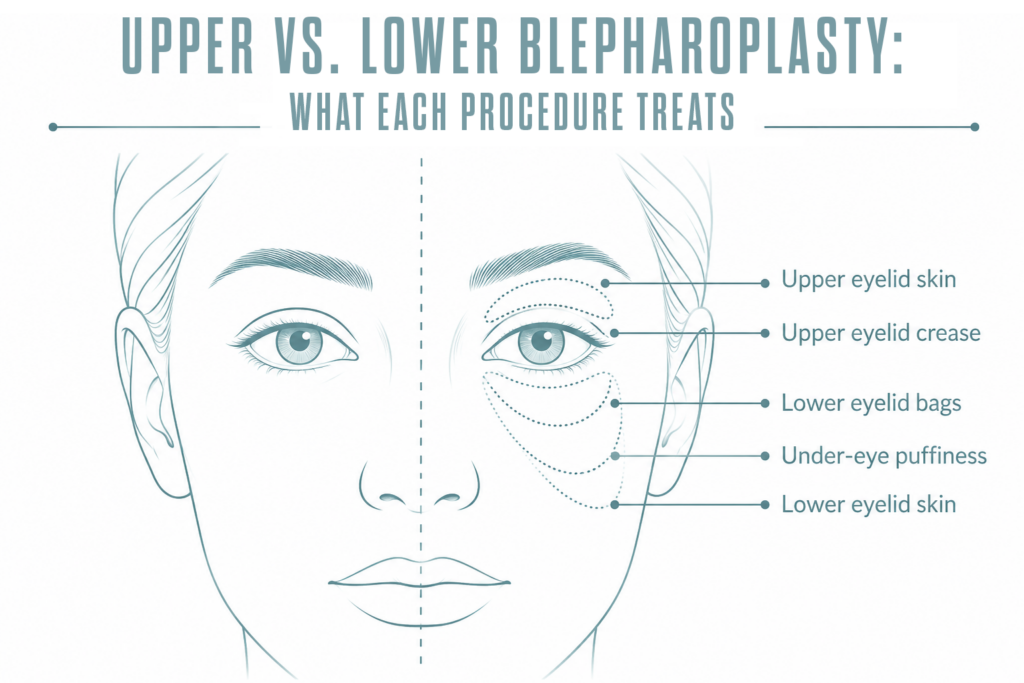
Types of Blepharoplasty Procedures
| Procedure | What It Addresses | Best For Patients Who Notice |
| Upper Blepharoplasty | Excess upper eyelid skin and heaviness | Hooded eyelids, heavy lids, difficulty applying makeup, reduced upper eyelid definition |
| Lower Blepharoplasty | Under-eye bags, puffiness, loose lower eyelid skin | Puffy under-eyes, bags that do not improve with skincare, tired-looking eyes |
| Combined Upper + Lower Blepharoplasty | Both upper eyelid heaviness and lower eyelid bags | Overall tired or aged eye appearance |
| Asian Blepharoplasty | Creates or refines an upper eyelid crease | Patients seeking a defined eyelid crease while preserving natural features |
| Functional Blepharoplasty | Excess upper eyelid skin affecting vision | Eyelid skin that interferes with peripheral vision or daily activities |
Upper Blepharoplasty: Correcting Heavy or Drooping Upper Eyelids
Upper blepharoplasty addresses excess skin and tissue on your upper eyelids. As you get older and your skin becomes less elastic, your eyelids can start to look heavy or hooded. In some cases, that excess skin can even interfere with your peripheral vision.
During eyelid lift surgery, an incision is placed within the natural eyelid crease, which helps hide the resulting scar. Excess skin is removed, and small amounts of fat might be adjusted if it’s necessary.
The result is a more open, refreshed appearance that makes your eyes look more defined but doesn’t change your natural features. Some of our female patients also share that it’s much easier to apply eye makeup.
Lower Blepharoplasty: Treating Under-Eye Bags and Puffiness
Lower blepharoplasty targets under-eye bags, puffiness, and loose skin under the eyes.
Unlike dark circles that are caused by pigmentation or lifestyle factors, under-eye bags are usually structural. That means that creams, skincare products, and even lifestyle changes can only do so much to improve the bags.
Depending on your goals and facial structure, the procedure may involve removing or repositioning fat, tightening skin, or both. The incision is usually hidden right below your lash line or inside the lower eyelid.
Dr. Neman explains the surgical techniques he uses during an under-eye blepharoplasty:
Upper vs. Lower Blepharoplasty
| Feature | Upper Blepharoplasty | Lower Blepharoplasty |
| Main concern | Heavy or hooded upper eyelids | Under-eye bags and puffiness |
| Common cause | Loose skin, tissue changes, aging | Fat protrusion, skin laxity, under-eye structure |
| Incision location | Natural upper eyelid crease | Below lash line or inside lower eyelid |
| Common result goal | More open, refreshed eyes | Smoother, less puffy under-eye area |
| Can be cosmetic or functional? | Yes | Usually cosmetic |
What to Expect With Specialized Blepharoplasty Procedures
Upper and lower blepharoplasty are the most common types of eyelid surgery, but there are also specialized procedures designed to address specific anatomical features or functional concerns.
Asian Blepharoplasty
Double eyelid surgery, also known as ‘Asian blepharoplasty,’ is a specialized form of upper eyelid surgery that creates or refines an upper eyelid crease to give patients a more almond-shaped eye.
Asian blepharoplasty isn’t one-size-fits-all– every procedure is customized depending on the patient’s anatomy and preferences.
Functional vs. Cosmetic Blepharoplasty
Blepharoplasty can be performed for cosmetic, functional, or combined reasons.
Sometimes, drooping eyelid skin can obstruct your vision and interfere with daily activities like reading or even driving. Patients may undergo testing to determine whether eyelid surgery could provide functional benefits. If that’s proven to be the case, insurance may help cover a portion of the procedure.
Cosmetic blepharoplasty focuses on improving the appearance of the eyes by addressing concerns like drooping upper eyelids or under-eye bags. The goal is to enjoy a more refreshed and youthful appearance.
Can I Combine Blepharoplasty With Other Facial Rejuvenation Procedures?
Since the eyes are just one part of an aging face, many of our patients choose to combine blepharoplasty with other facial rejuvenation procedures, both surgical and non-surgical.
Our patient Shelby combined an eyelid lift with a brow lift and laser resurfacing. This is one of the most common procedure combinations we see. You can hear her story here:
Treating multiple areas at once can give you more balanced, natural-looking results while allowing you to recover from everything at once.
During your consultation, your surgeon can help you determine if eyelid surgery will help you achieve your goals, or if a combination approach might be a better fit.
Contact our office to schedule a consultation and determine if blepharoplasty might help you achieve the results you’re looking for.
Frequently Asked Questions
Am I a candidate for blepharoplasty?
- You may be a good candidate for blepharoplasty if you have one or more of the following:
- Excess skin on the upper eyelids that creates a hooded appearance
- Upper eyelids that make you look tired or older than you feel
- Trouble applying makeup because of loose eyelid skin
- Excess skin that rests against your eyelashes
- Reduced peripheral vision caused by drooping upper eyelid skin
Candidates also need to have good overall health. You should be a nonsmoker or willing to stop smoking during recovery. Most importantly, you should have realistic expectations about the results you can achieve.
How long do results last?
Blepharoplasty results are long-lasting, but your face does continue to age. For many people, upper eyelid surgery can last 5-7 years or longer. Lower eyelid surgery results often last a lifetime.
What is recovery like?
Most patients experience swelling, bruising, and mild discomfort for the first week after surgery. These side effects gradually improve, and many people can return to their normal work and social routine within a week or two. Your surgeon will provide specific directions about the recovery process that include suggested sleeping positions, activity restrictions, and follow-up appointments.
What’s the typical cost range for blepharoplasty?
The cost range for blepharoplasty can be anywhere from $5,000-$14,000. At Neaman Plastic Surgery, upper eyelid surgery costs between $6,000-$8,000, and lower eyelid surgery costs between $9,000-$12,000. These fees include the doctors’ fees, surgical center fees, anesthesiologist fees, pre-surgical appointments, and follow-up care. Financing is available to help accommodate a range of financial needs.
Are there non-surgical options for eyelid rejuvenation?
Yes. Depending on your concerns, non-surgical treatments such as Botox, dermal fillers, laser skin resurfacing, and skin-tightening procedures can help improve wrinkles, volume loss, and skin quality around the eyes. These treatments can create a more refreshed appearance with little to no downtime, but they can’t remove excess eyelid skin or completely address noticeable under-eye bags. If you have significant skin laxity or drooping eyelids, blepharoplasty typically provides more dramatic and longer-lasting results. A consultation can help determine whether a non-surgical treatment, eyelid surgery, or a combination of both is the right approach for you.